What "low-carbon" means at the spec sheet level
Lifecycle assessment is the discipline most procurement documents are reaching for, even when they do not use the term. Four components determine whether a product genuinely qualifies.
- Material Composition and Substrates: Compliance must be documented directly at the bill of materials level, verifying high recycled content, FSC-certified timber sources, and strictly formaldehyde-compliant substrates.
- Manufacturing Location and Freight Logistics: Transport carbon accumulates rapidly per kilometre and per kilogram. A workstation installed in a Sydney CBD fit-out but freighted entirely from Europe carries the massive embodied carbon of its journey, heavily penalising the project's overall ESG metrics compared to locally manufactured alternatives.
- Design for Disassembly: The structural engineering must allow components to be unbolted, remanufactured, and reinstalled over time, rather than destined for a landfill at the end of a ten-year lease cycle.
- End-of-Life Pathways: Suppliers must provide auditable evidence of a product stewardship program, ensuring the furniture does not transform back into a carbon liability when the floor-plate eventually restacks.
A product that scores on one and fails on three is a marketing position with a footnote.
Where the budget premium is real, and where it isn't
Local manufacture often reduces total project cost, not increases it. Lead times shorten, freight drops, snagging is faster because the factory is in the same time zone. The carbon saving is a structural by-product of an operational advantage that already justified itself on commercial grounds.
Design for disassembly carries a different cost profile. Modular workstation systems with bolt-fixed frames sit a few percentage points above welded equivalents at first install. At year ten, when the floorplate restacks for the third time, the modular product is reconfigured for labour and replacement components, not replaced wholesale. Total cost of ownership over a twelve-year lease is materially lower. The tender stage unit-price comparison is reading the wrong number.
The category that does carry a genuine premium is certification compliance, particularly AFRDI Green Tick across custom finish ranges. That cost is real, auditable, and increasingly required by Green Star Performance, mandatory for all enrolled projects from 1 January 2026.
A worked example: the Eko range
Our Eko range is what this conversation looks like in finished products. Each surface is produced from 100% recycled Australian HDPE, high-density polyethylene collected and processed locally, melted and pressed into surface tops with a one-of-a-kind terrazzo pattern on every piece. No two surfaces are identical since the source material is not identical.
What Eko demonstrates matters more than what it markets:
- The supply chain is functional. Australian HDPE collection and processing is a scaled industrial reality, not an experimental loop. The material exists in quantity and can be specified into real project programmes without sourcing risk.
- The aesthetic holds its own. Eko sits in reception, lounge and breakout settings because the surface reads as a deliberate finish choice, not a sustainability gesture. The terrazzo effect is a finished commercial product.
- The numbers reconcile. Eko prices into mid-tier project budgets, not premium-only ones. The recycled-content credential is not financed by a price ceiling that excludes most specifiers.
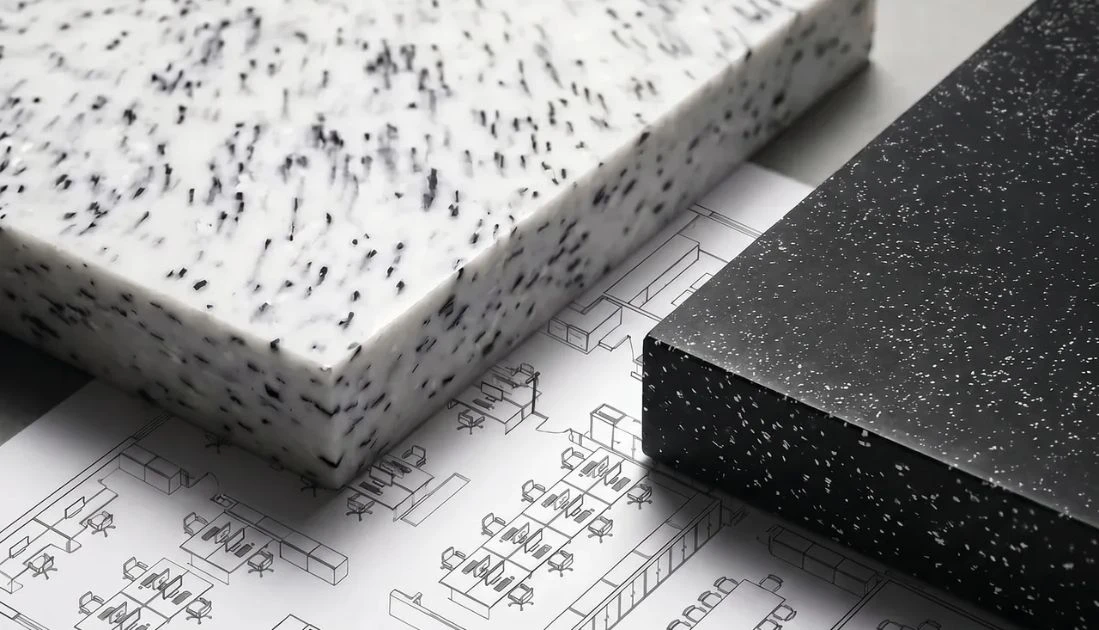
For those looking at the sustainability page of a brief and trying to identify which products can carry certification weight without forcing a budget renegotiation, Eko is a worked example of how the answer can actually fit on a single spec sheet.
What to demand from a supplier's response
A tender response that claims low-carbon status without producing certificates is a marketing claim. A response that produces certificates without naming the standard is a half-answer.
The procurement-grade response names the standard, supplies the certificate number and expiry date, and identifies where in the range each certification applies.
The standards worth knowing: AS/NZS 4438 covers office chairs (Level 6 for full-time commercial use), AS/NZS 4442 covers desks and workstations, AS/NZS 4266.16 E0 covers formaldehyde emissions, AFRDI Blue Tick covers performance, AFRDI Green Tick (Silver, Gold or Platinum) covers sustainability, and GECA Level A is the independent sustainability assessment. These are not interchangeable. A brief that names the wrong one will not survive an audit.
The right question to ask a supplier is not "is your product sustainable" It is: which certificates apply to which lines, what is the chain of custody on the raw materials, and what is the documented end-of-life pathway for each product family. If the answer takes longer than five minutes, the answer is usually the one a specifier wants.
The new baseline
Low-carbon fit-outs in Australia are not a premium category any more. They are the baseline procurement question, and the cost is not the price premium the industry argued about for a decade. The cost is the time it takes to verify a supplier's claim, and the procurement risk a client carries if that verification has not been done.
For the specifier writing the next brief, the lever is in the documentation, not the marketing.
----
Krost manufactures from Smithfield, NSW, and holds AFRDI Green Tick and ISO 14001 certification across qualifying ranges. Our Eko range and sustainability documentation pack is available to specifying architects, designers and procurement teams on request across Sydney, Melbourne and Brisbane showrooms.
-----
References:
Australasian Furnishing Research and Development Institute 2024, AFRDI Blue Tick Product Certification, Furntech, Launceston, viewed at https://www.furntech.org.au/afrdi-blue-tick/.
Australasian Furnishing Research and Development Institute 2024, AFRDI Green Tick Sustainability Certification, Furntech, Launceston, viewed at https://www.furntech.org.au/afrdi-green-tick/.
Good Environmental Choice Australia 2024, Furniture, Fittings, Foam & Mattresses Standard (Level A), GECA, Sydney, viewed at https://www.geca.eco/standards.
Green Building Council of Australia 2025, Green Star Performance v2, GBCA, Sydney, viewed at https://new.gbca.org.au/green-star/rating-system/performance/.
International Organization for Standardization 2015, ISO 14001:2015 Environmental Management Systems, ISO, Geneva, viewed at https://www.iso.org/iso-14001-environmental-management.html.
Standards Australia 2017, AS/NZS 4266.16: Reconstituted wood-based panels — Methods of test, Formaldehyde emission, Standards Australia, Sydney, viewed at https://www.standards.org.au.