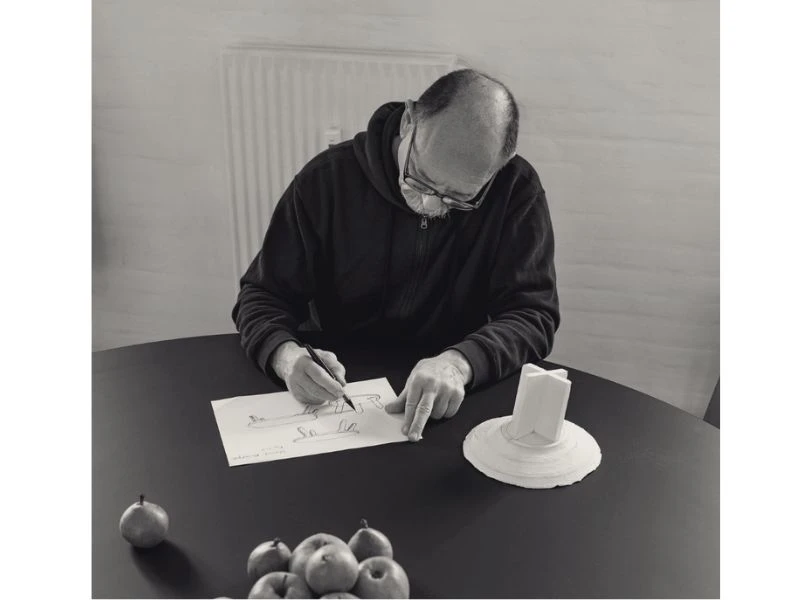
Boris Berlin doesn't design loudly. The Copenhagen-based industrial designer, born in Leningrad and a founding partner of Boris Berlin Design, Komplot Design, and Iskos-Berlin Design, has built a four-decade practice on a single, stubborn idea: that a good object tells a clear story through its material, its making, and the logic of how it stands up.
His work sits in MoMA, the V&A, Design Museum Denmark, and the Vitra Design Museum, and yet his stated ambition remains disarmingly plain. The best design, he has said, is one you recognise though you have never seen it before.
That sensibility lands squarely in the Monolite.
The name is the brief. Berlin set out to design a table that read as a single, settled object—the visual weight of something hewn rather than assembled. But a true monolith is dead weight, and a boardroom table has to be moved, levelled, and lived with. The interest, for Berlin, was in the contradiction: how to deliver the presence of a monolith without the mass.
The answer is in the base.
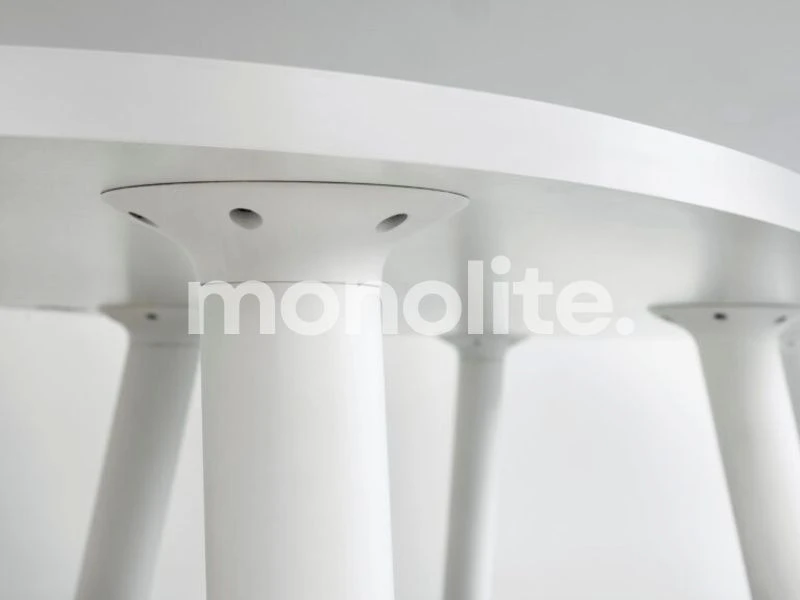
Most boardroom tables hide their structure inside an apron or a stretcher frame slung beneath the top. Monolite refuses that vocabulary entirely. The tabletop is self-bearing across a long span, with no skirt, no rail, no underframe to interrupt the line. What you see instead is what holds it up: thick, round tubular legs with a wide stance, planted directly into the floor.
Berlin's engineering move is the oversized steel saddle plate where each leg meets the underside of the top. It is the quiet hero of the piece. The saddle distributes load across a broad footprint of the worktop, which is what allows the top to stay rigid over long meeting-room spans without sagging or relying on a secondary frame. The 15mm of levelling adjustment built into each foot does the unglamorous work of keeping that geometry true on imperfect floors, the kind of detail that matters at month forty-eight, not month one.
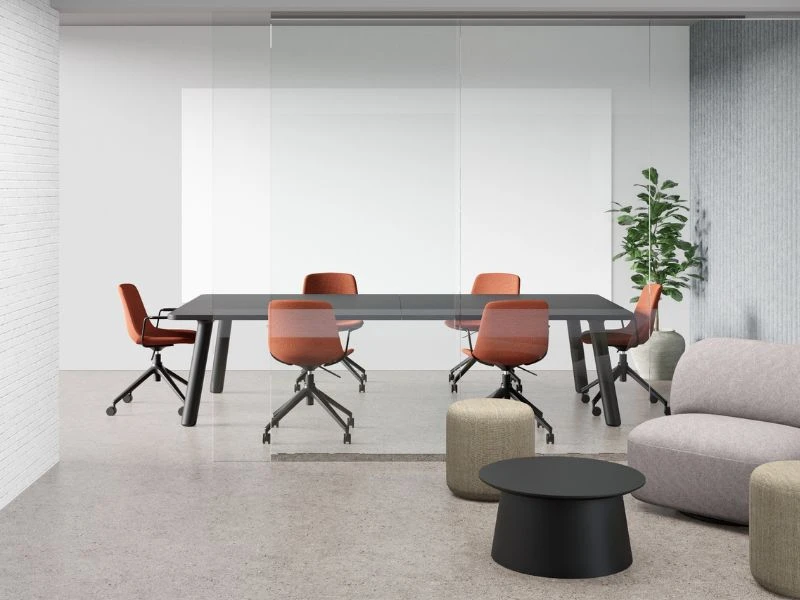
The result is a base that reads as substantial but composes as restraint. Powder-coated in matte black or white, the legs hold their monochrome character without catching light or asking for attention. It is a table that fills a room by being still in it.
The legs are made in Europe to Berlin's specification. The tops are made locally in Australia and can be specified for covered outdoor use when paired with a compact laminate top. That last specification widens Monolite's range considerably. The same architectural language carries from a top-floor boardroom to a terrace meeting setting without redrawing the design.
For commercial architects and workplace designers specifying long-life boardroom infrastructure, Monolite reads as a considered piece of European product design backed by local manufacturing. The 33mm worktop, the rounded corner profile, the ten-year warranty—these are the technical underwriting. Berlin's contribution is the part you feel before you read the spec sheet.
A table can announce itself, or hold the room. Monolite was drawn to do the second. Explore the meeting, breakroom, and counter editions.
.webp)
Get expert advice for your next project.
Order our latest print or digital guide.
Shop in-stock items for immediate dispatch.