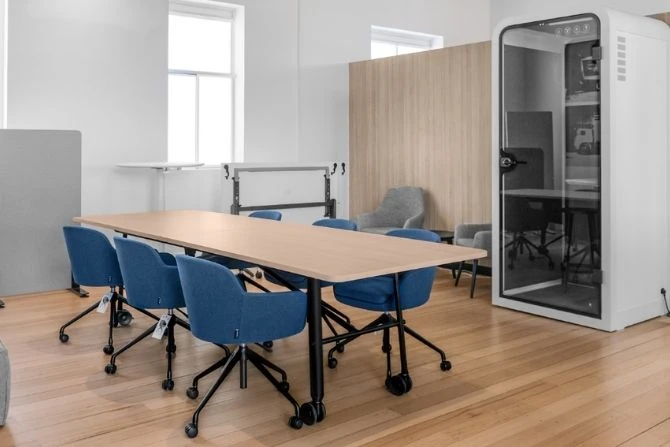
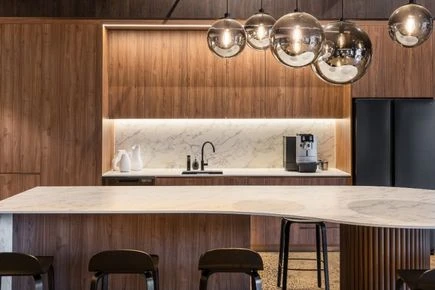
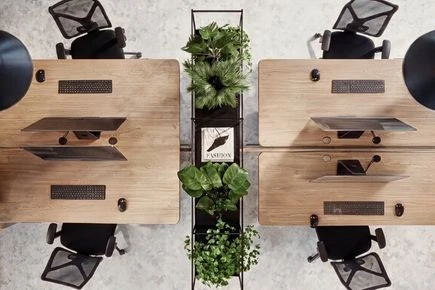
Where our Zora, Breakaway Zone and Breakaway Pod earn their place
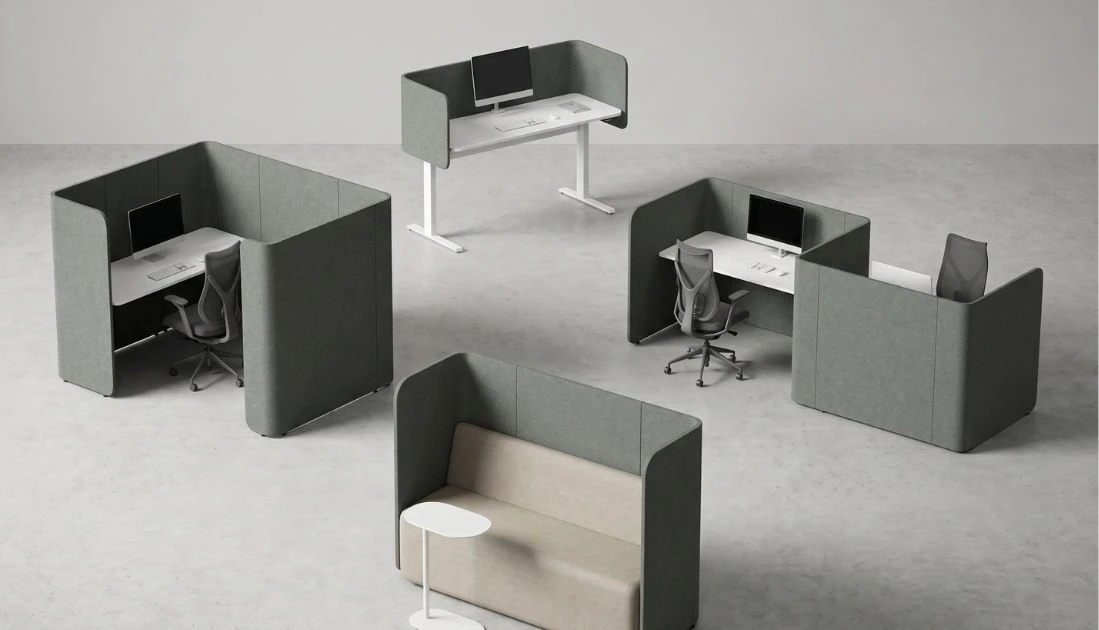
For the individual workpoint that needs an acoustic envelope without committing to a completely sealed room, our Zora range introduces the exact intermediate condition that most open plans lack. This U-shaped acoustic privacy screen, engineered with radius corners and premium fabric finishes, wraps around a single desk or small group setting. The worker remains on the floor and visible to their team, but the visual and acoustic sensory load drops dramatically.
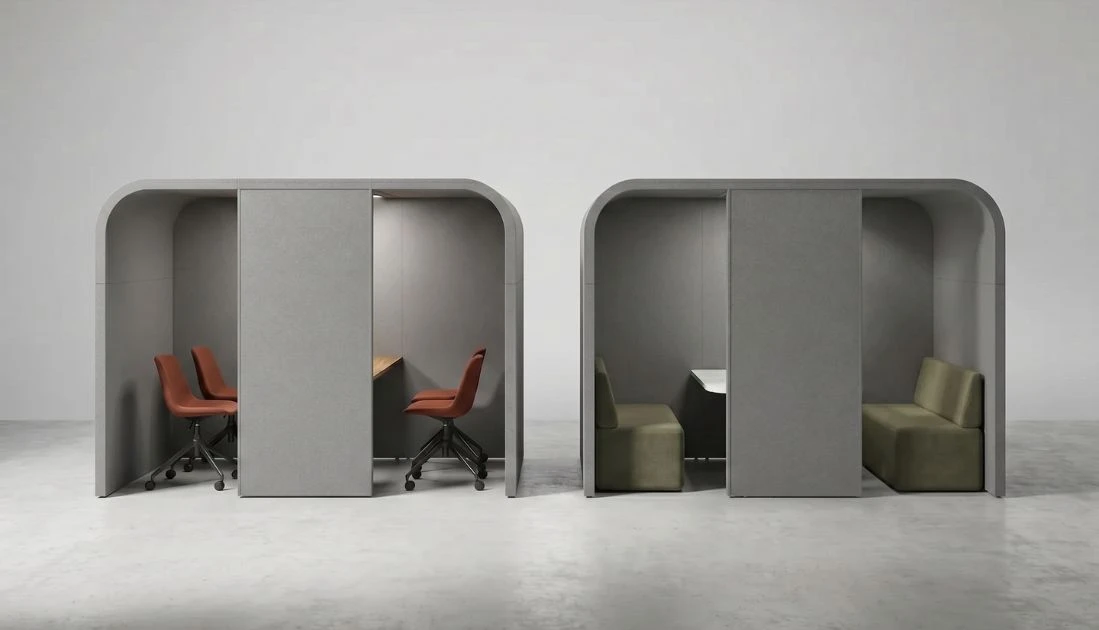
Our Breakaway Zone takes the layering one step further. Designed as a semi-enclosed acoustic setting, it carves out a defined space within the open plan without sealing the worker off entirely. The zone is the right call when a worker needs more than a desk-side screen but less than a closed room, a focus block, a one-on-one conversation, or a small collaborative huddle that still belongs visibly to the wider floor.
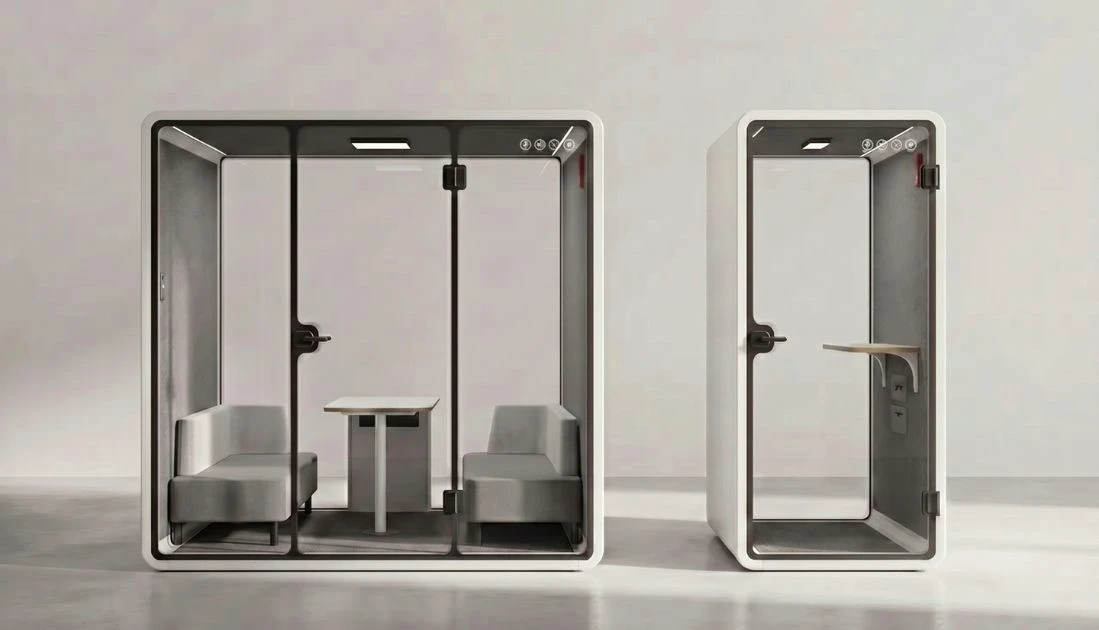
When a project brief requires a complete acoustic break for a deep focus block or a sensitive conversation, our Breakaway Pod handle the transition. The enclosed acoustic pod sits cleanly on the floorplate, allowing a worker to step inside for absolute isolation while the wider open plan continues uninterrupted around them.
The primary challenge for architects and designers is implementing these subtle boundary changes without disrupting the architectural flow of the wider property. This requires flexible furniture systems designed to define space through form and material rather than permanent trade construction.
What to leave out of the brief
Achieving a genuinely layered outcome requires breaking a few entrenched commercial brief-writing habits:
- Treating the Quiet Pod as the whole answer: Enclosed acoustic pods are an essential component of a workplace, but they are not a complete solution. A floor plan featuring a singular focus room and no intermediate sensory settings has simply skipped the substantive part of the strategy.
- The Social Cost of Total Isolation: Focus alcoves that require a worker to physically withdraw behind a closed door carry an unintended social barrier. Because the action signals a stark detachment from the group, these spaces are often underutilised. Conversely, open-fronted alcoves featuring built-in visual and acoustic softening invite frequent, spontaneous use throughout the day.
- Late-Stage Sensory Retrofitting: True sensory zoning must be embedded directly at the initial floorplate planning stage. Attempting to retrofit an acoustic balance during year two using topical rugs and generic divider panels after an unfavourable post-occupancy survey lands is both cost-inefficient and structurally compromised.
A better open plan, by design
A sensorially layered floor is not a specialist deliverable. It is a more honest open plan, one that recognises the workforce moving across it does not occupy a single sensory setting all day. The floor stops asking people to choose between participation and concentration. That is the design move. The product systems and the spatial conditions exist to deliver it. What it asks of the designer is the willingness to plan in gradients rather than zones, and to treat sensory variety as part of the architectural intent, not an inclusion afterthought.
—---
Discover our latest space division solution here or Book a tailored sensory layering consultation with our experts here, with showrooms in Mascot, West Melbourne and East Brisbane.
—-----
References:
Australian Bureau of Statistics 2025, Inclusion and Diversity, ABS, Canberra, viewed at https://www.abs.gov.au/about/our-organisation/our-commitments/abs-inclusion-and-diversity-strategy/latest-release
Australian Public Service Commission 2025, APS Employee Census 2025, APSC, Canberra, viewed at https://www.apsc.gov.au/initiatives-and-programs/workforce-information/research-analysis-and-publications/aps-employee-census-2025.
Leesman 2025, The Workplace Why, Leesman Index, London, viewed at https://www.leesmanindex.com/articles/the-workplace-why/.
Yadav, M, Kim, J, Hongisto, V, Cabrera, D & de Dear, R 2025, 'Noise disturbance and lack of privacy: Modeling acoustic dissatisfaction in open-plan offices', Journal of the Acoustical Society of America, vol. 157, no. 5, pp. 3378–3389, viewed at https://www.arxiv.org/pdf/2501.15744.